Welcome, you are in




Typical Colombian words: a journey through our culture
Discover different typical Colombian words that reflect our culture, joy, and unique way of life.

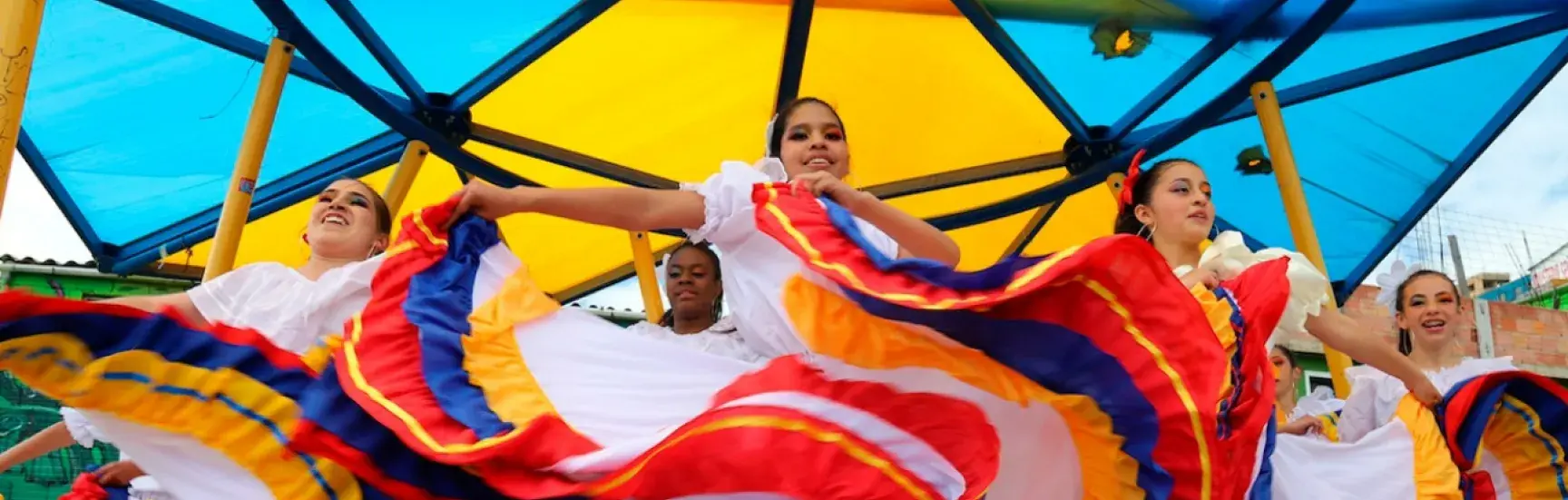
Spanish is a language shared by many countries, however in every corner it acquires unique nuances that make it special. In Colombia, those particularities are expressed in a wide variety of Colombian words that have arisen from our culture and that within the country can be understood with great ease. These Colombian expressions are a reflection of our way of living, relating and conveying emotions. That is why today we invite you to discover some of those terms that are part of the identity of the country of beauty and that you surely also know.
Words you can't miss at a party

In Colombia, parties are not only experienced, they are also expressed through a cultural language. Some Colombian idioms capture that experience perfectly and have very particular nuances that express the language of the country of beauty.
Guayabo: After a night of dancing and toasts, many Colombians wake up with “guayabo.” This word describes that physical discomfort that comes after a good celebration and sometimes makes one promise: “I won't drink again.” Guayabo groups all the symptoms suffered after having some polas (beers) with friends. “This hangover I'm having is hitting me hard.”
Rumbear: When the weekend arrives, rumbear becomes an essential plan. This word means going out to party, usually to dance, whether at a small gathering or at a place with many friends. It is one of the Colombian idioms used to refer to a celebration. In some regions synonyms such as “parranda”, “foforro” or “farra” are also heard. However, the expression “rumbear” captures the essence of our celebration culture. “Get ready because this Friday we're definitely going out to party!”
You may be interested in: The Estereo Picnic Festival: Bringing all five senses alive at once
Words referring to objects or foods

In Colombia, many of our daily customs are so rooted in culture that they have given rise to specific words to name objects and foods in a unique way. These terms are part of routine and, beyond being expressions, represent traditions and ways of sharing.
Onces: Having some “onces” is a very Colombian custom that consists of enjoying a small snack in the middle of the afternoon. Depending on the region, it can be between lunch and dinner, or between breakfast and lunch. Onces are a social moment: the perfect excuse to share a hot drink, a roll, an arepa or a piece of cake in good company. “Do you want to go for some onces this afternoon?”
Pintadito: In Colombia the coffee can be served in a thousand ways, and one of them is the “pintadito.” It is a filtered coffee to which a splash of milk is added, achieving a milder flavor than the traditional tinto. In some places it is also known as “cortadito” and it can vary in strength depending on whether a lighter or stronger drink is preferred. This beverage reflects the care Colombians put into the coffee ritual. “Are you craving a pintadito?”
Words that express emotions

Spanish in Colombia is full of words that convey emotions. Many of our adjectives are unique and have become an identity hallmark: a way to express enthusiasm, admiration or affection in a very authentic way. Words like chévere or berraco are so typical that in Colombia they can be easily understood.
Bacano: It is used to describe something very good, nice or fun, but also to highlight a person's friendliness and kindness. Thus, one can talk about a bacano landscape, a bacana party or a bacano friend. It is a versatile word that reflects our positive way of seeing things. “What an amazing landscape,” “What a great party!”, “He is a bacán.”
Qué chimba: The expression “qué chimba” is common in informal conversations, especially among younger people. It is used to refer to something that is very good, attractive or exciting. It can apply to a song, an unexpected plan or even an object. It is a colloquial term and reflects the freshness and spontaneity of Colombian language. The concert was awesome!
You may be interested in: The book of warmth - Colombia’s gift to the world
Words and phrases that refer to actions

In everyday life, Colombians not only name objects or describe situations with our idioms, we also have expressions to talk about very common actions. These action-related phrases are part of our identity and convey the particular way we communicate, always with a touch of closeness.
Hacer una vaca. The expression “hacer una vaca” is very common at social gatherings. It means to collect money among several people for a shared goal, such as buying food, drinks or even organizing an outing. What is special about this action is that, beyond the economic aspect, it represents collaboration and friendship. Many times, those “vacas” end in joyful gatherings full of music and dancing. “Let's pool some money to buy the ticket.”
Ponerse las pilas. It is a phrase we use to motivate or invite someone to act decisively. It means to get organized, move and start a task or purpose. It can be used in academic or even family contexts, always with the intention of encouraging and challenging someone to give their best. “You need to get your act together at school.”
As you go through these expressions, it becomes clear that Spanish in Colombia is much more than a shared language: it is a celebration of our cultural diversity. From the coastal words, full of freshness and Caribbean flavor, to the expressions of the paisas, full of wit and closeness, passing through the words of people from Cali and Bogotá, which convey rhythm and joy, each region has contributed its unique stamp to our way of speaking. These words not only enrich our communication, they also remind us that Colombia is a country of diverse voices that together build a common identity.